Background
Although the doctrine of the Eucharist was well established at the Council of Trent (1545-63), new challenges arose during the Enlightenment in the 18th century and the Industrial Revolution in the 19th century. Certain intellectual advances, scientific developments, political and social upheavals posed questions and doubts to the traditional teaching of the Holy Eucharist. Therefore, in a pastoral effort to respond to the contemporary issues of his day and once again put forward the Eucharist as the answer to the social, spiritual, and moral issues of the time, Pope Leo XIII published an encyclical letter on the Holy Eucharist in 1902 titled Mirae Caritatis (“Wonderful Love”). This was the last encyclical of his long pontificate (80+ encyclicals over a 25 year period) and it was published the year before his death.

The Problem: Lack of Charity
“If anyone will diligently examine into the causes of the evils of our day, he will find that they arise from this, that as charity towards God has grown cold, the mutual charity of men among themselves has likewise cooled. Men have forgotten that they are children of God and brethren in Jesus Christ; they care for nothing except their own individual interests; the interests and the rights of others they not only make light of, but often attack and invade. Hence frequent disturbances and strifes between class and class: arrogance, oppression, fraud on the part of the more powerful: misery, envy, and turbulence among the poor” (11).
Simply put, the real problem is a lack of charity. Pope Leo XIII spoke of “an attitude of defiance towards God… in which many are hurried on with more passionate fury, than the desire utterly to banish God not only from the civil government, but from every form of human society” (17). In a special way, when we show a lack of charity towards Jesus in the Eucharist, everything falls apart (cf. 16). Men “anxiously strive for prosperity” (6) more than to worship God. The pursuit of wealth rather than the pursuit of God.
The Answer: The Eucharist
To explain the answer, I like categorizing Pope Leo XIII’s insights into 3 quotes from St. Augustine:
“O sacrament of love! O sign of unity! O bond of charity!” – St. Augustine
1: “O sacrament of love!”
Rather than “seek a remedy in legislation, in threats of penalties to be incurred, or in any other device of merely human prudence” (11), the answer is found in the “charity that Christ brought into the world” (11). Today, Christ brings this charity into the world through the Sacrament of Charity, that is, the Eucharist. Christ instituted the Eucharist to awaken charity towards God and promote mutual charity among men (cf. 11). If only “men would but ponder well the charity which Christ has shown in this Sacrament” (11), whereby Christ “has in a manner poured out the riches of His divine love towards men” (Trent, XIIL, De Euch. c. ii.), this sacrament of love would transform the world once again.
2: “O sign of unity!”
The Eucharist “is a divine gift proceeding from the very Heart of the Redeemer, Who “with desire desireth” this singular mode of union with men, a gift most admirably adapted to be the means whereby the salutary fruits of His redemption may be distributed” (1).
Just as the early Church was united, “one heart and one soul” (Acts 4:32) due to their frequent “communion of the breaking of bread” (4:42), so too will we both united in the Eucharist (see 1 Cor 10:17).
“Very beautiful and joyful too is the spectacle of Christian brotherhood and social equality which is afforded when men of all conditions, gentle and simple, rich and poor, learned and unlearned, gather round the holy altar, all sharing alike in this heavenly banquet” (11).
3: “O bond of charity!”
The Eucharist is a “bond of charity” to join all Christians with Himself. Pope Pius XIII says that the chief benefit of the Eucharist is “life” – Christ’s divine life. He came that we “may have life, and may have it more abundantly” (John 10:10). In this supernatural food, Christ changes us into Himself.
“That genuine charity, therefore, which knows how to do and to suffer all things for the salvation and the benefit of all, leaps forth with all the heat and energy of a flame from that most holy Eucharist in which Christ Himself is present and lives, in which He indulges to the utmost. His love towards us, and under the impulse of that divine love ceaselessly renews His Sacrifice. And thus it is not difficult to see whence the arduous labours of apostolic men, and whence those innumerable designs of every kind for the welfare of the human race which have been set on foot among Catholics, derive their origin, their strength, their permanence, their success” (13).
Practical Goal of Mirae Caritatis: Frequent reception of the Eucharist
“[T]he chief aim of our efforts must be that the frequent reception of the Eucharist may be everywhere revived among Catholic peoples. For this is the lesson which is taught us by the example, already referred to, of the primitive Church, by the decrees of Councils, by the authority of the Fathers and of the holy men in all ages. For the soul, like the body, needs frequent nourishment; and the holy Eucharist provides that food which is best adapted to the support of its life. Accordingly all hostile prejudices, those vain fears to which so many yield, and their specious excuses from abstaining from the Eucharist, must be resolutely put aside; for there is question here of a gift than which none other can be more serviceable to the faithful people, either for the redeeming of time from the tyranny of anxious cares concerning perishable things, or for the renewal of the Christian spirit and perseverance therein. To this end the exhortations and example of all those who occupy a prominent position will powerfully contribute, but most especially the resourceful and diligent zeal of the clergy. For priests, to whom Christ our Redeemer entrusted the office of consecrating and dispensing the mystery of His Body and Blood, can assuredly make no better return for the honour which has been conferred upon them, than by promoting with all their might the glory of his Eucharist, and by inviting and drawing the hearts of men to the health-giving springs of this great Sacrament and Sacrifice,seconding hereby the longings of His most Sacred Heart” (19).
Extra 1: Pope St. Pius X
Building upon this chief aim of Pope Leo XIII, Pope St. Pius X, often called “the Pope of the Eucharist,” frequently extolled the reception of Holy Communion as the “shortest and safest way to get to heaven” and even issued the decree Quam Singulari in 1910, which lowered the age of First Communion from 12 to 7.
Extra #2: St. Paschal Baylón
The Spanish mystic Saint Paschal Baylón (1540-1592) was called the “Seraph of the Eucharist” because of the angelic devotion with which he approached and spoke of the real presence of Christ in the consecrated Host (especially during the spread of Protestantism). For this reason, in 1897, Leo XIII proclaimed him patron of Eucharistic works and congresses.
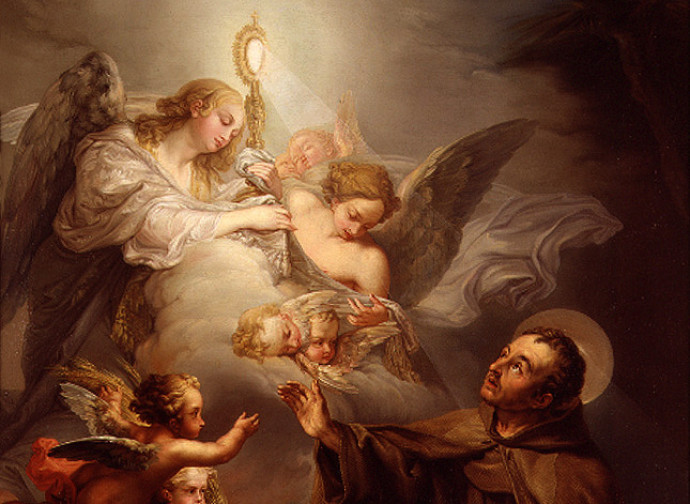


 Prodigal Catholic
Leave a comment