In this book, Fulton Sheen looks at how Our Lord made reparation for the 7 deadly sins on the Cross through His 7 last words from “the pulpit of the Cross” (St. Augustine).
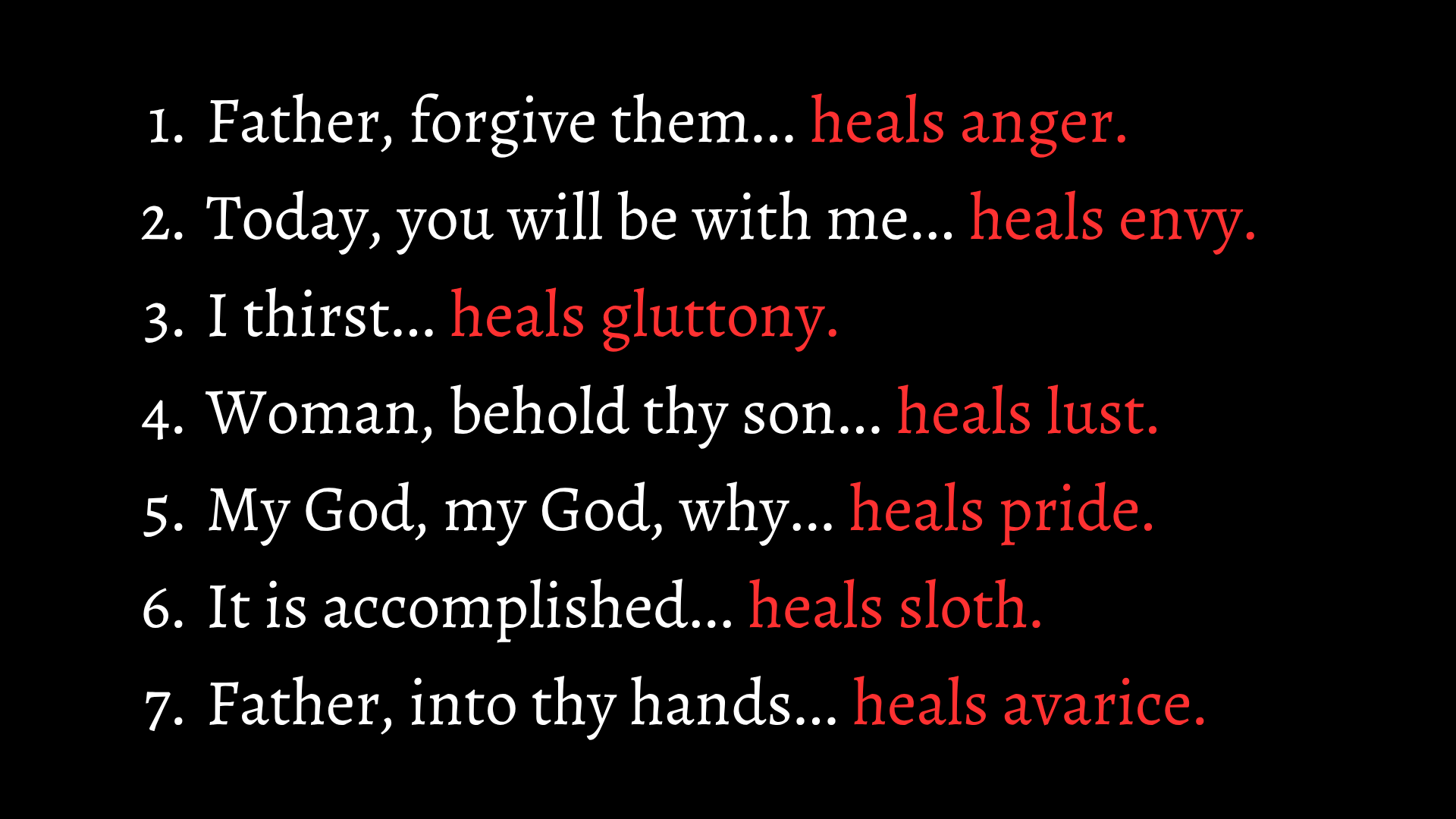
1. Wrath (Anger) vs. “Father, forgive them for they know not what they do.”
How did Our Blessed Lord make reparation for this sin? Jesus makes perfect reparation for this sin on the Cross when He prays, “Father, forgive them, for they know not what they do” (Lk 23:34). In the very moment of the greatest injustice ever committed, Christ does not accuse in anger but intercedes with mercy. He introduces a divine logic that overturns sinful anger: instead of emphasizing guilt, He points to ignorance. Where we would say, “They knew exactly what they were doing,” Christ reveals how little we truly understand—of ourselves, of others, and of the deeper movements of the human heart. As Sheen writes, “Only a Lord Who thought so little of Himself as to become man and die like a criminal could ever forgive the weakness of those who crucified Him” (18).
What is the lesson for us? From this flows a radical lesson: forgiveness must have no limits. Jesus forgives while innocent, without first being forgiven, and in the midst of suffering. This means that forgiveness is not a reaction but a decision rooted in love—a surrender of the right to revenge. The more we recognize our own blindness and need for mercy, the more we become capable of extending it to others. In forgiving, we participate in the very heart of Christ, trusting that as we release others, God in His mercy will also release us. And if we forgive from the heart, then on Judgment Day, God Himself will “forget how to add and will know only how to subtract,” no longer remembering our sins—saving us, once again, through divine ignorance (20).
2. Envy vs. “This day, thou shalt be with Me in Paradise.”
How did Our Blessed Lord make reparation for this sin? Our Lord was unceasing in His preaching against envy, which is fundamentally sadness at another’s good. To those who were envious of (1) mercy (angels rejoice more over 1 sinner…), of (2) wealth (lay up treasure in heaven…), of (2) power (put a child in their midst…). Jesus overturns envy most powerfully on the Cross when He says to the good thief, “Today you will be with me in paradise” (Lk 23:43). At the very moment of death, He freely gives everything—mercy, forgiveness, heaven—to a man who had done nothing to earn it. Envy would protest, “That’s not fair.” But Christ reveals a different logic: grace is not limited, and another’s salvation does not diminish our own. Where envy competes, Jesus delights in giving. He shows that love is not a scarce resource, but an infinite gift.
What is the lesson for us? Envy is healed when we learn to rejoice in the good of another and to see with mercy rather than comparison. The two thieves reveal this clearly: one, blinded by envy, asked to be taken down; the other, moved by humility and trust, asked to be taken up—and received paradise. As Sheen recounts: “Like the thief on the left… No one in the history of the world has ever come closer to Redemption, and yet no one has ever missed it so far. His envy made him ask for the wrong thing: he asked to be taken down when he should have asked to be taken up” (27). The cure for envy is not comparison, but compassion—to look at others not as rivals, but as souls loved by God. And when we rejoice in their good, we begin to share in it.
3. Lust vs. “Woman, behold thy son… Behold thy mother.”
How did Our Blessed Lord make reparation for this sin? Our Lord began making reparation for lust from the very first moment of the Incarnation, choosing to be born of a Virgin (35), sanctifying human love at its source. This reparation reaches its fullness on Calvary. There, in atonement for impure thoughts and desires, He is crowned with thorns; in reparation for sins of shame, He is stripped of His garments; and in reparation for the lusts of the flesh, His own flesh is so broken that “all His bones can be counted” (cf. Ps 22:17) (36). Yet He goes even further. In the midst of His suffering, Jesus freely surrenders the two most sacred human relationships: He gives His Mother to the beloved disciple, and the disciple to His Mother (37). In doing so, He transforms natural affection into supernatural love—no longer possession, but pure gift.
What is the lesson for us? The deepest lesson is this: the heart does not overcome impure love merely by resisting it, but by being captured by a greater love. At Calvary, Jesus—stripped, wounded, and totally self-giving—reveals that true love is not about taking, but about giving. Lust says, “What can I get?” Love says, “What can I give?” This is why the remedy for lust is not simply to “try harder,” but to love higher: to love Christ more, to love Mary more, to love purity, vocation, and souls more. When the heart is set on a greater fire, lesser passions begin to lose their hold. The Cross shows us that chastity is not the death of love, but its purification—not less love, but better love. Beneath the Cross, as Jesus entrusts us to His Mother, we learn that the path to purity is to remain close to the Crucified and to Mary, until selfish desire is transformed into holy, self-giving love.
4. Pride vs. “My God, My God, why hast thou forsaken me.”
How did Our Blessed Lord make reparation for this sin? Jesus’ entire life is a descent in humility to heal our pride. From the hidden life of Nazareth to the washing of feet, He constantly lowers Himself. But this reaches its summit on the Cross. There, the Son of God enters into the deepest consequence of human pride: separation from God. In His cry, “My God, My God, why have You forsaken Me?”, Jesus allows Himself to experience the desolation that pride creates—though He Himself is without sin. The One who is equal to the Father chooses to stand in the place of sinners, emptying Himself completely (cf. Phil 2:6–8). Pride sought to rise; Christ chose to descend. In this radical humility, He makes perfect reparation.
What is the lesson for us? The lesson is simple and demanding: empty yourself so that God may fill you. Pride fills the soul with the self, leaving no room for grace. Humility creates space for God. The paradox of the Christian life is this: the less we cling to ourselves, the more God can act in us. The higher the building, the deeper the foundation; the greater the soul, the deeper its humility. True humility is not thinking less of ourselves, but seeing the truth: that everything we have is a gift, and without God we can do nothing. The saints understood this well. St. Philip Neri, seeing a criminal led to prison, said, “There goes Philip Neri, except for the grace of God.” To conquer pride, then, we must learn to glory not in ourselves, but in God—to depend on Him, to receive everything from Him, and to return everything to Him. For God resists the proud, but gives grace to the humble (James 4:6).
5. Gluttony vs. “I thirst.”
How did Our Blessed Lord make reparation for this sin? Jesus makes reparation for gluttony through His radical poverty and self-denial, brought to its summit on the Cross. There, He speaks one of His shortest and most piercing words: “I thirst.” The One who created every good thing refuses even the simplest consolation. He enters into the suffering of deprivation to atone for our excess. Yet His thirst goes deeper than the body. Beneath the physical agony is a divine longing: a thirst for love, for souls, for our hearts. While we seek to satisfy ourselves with created things, Christ reveals that only God can satisfy the human heart—and that God Himself thirsts to be loved in return.
What is the lesson for us? The lesson is this: train your desires to hunger for God above all else. The problem is not that we hunger, but what we hunger for. Sheen said: “The development of character depends upon which hunger and thirst we cultivate… Tell me your hungers and your thirsts and I will tell you what you are” (61). When bodily desires dominate, the soul becomes weak and restless; but when desire is purified and directed toward God, it becomes strong and free. Fasting, then, is not about punishing the body, but about reordering love—teaching the body to serve the soul, and the soul to seek God. The question at the heart of gluttony is simple: Does my soul rule my body, or does my body rule my soul? Christ’s cry, “I thirst,” is an invitation. He thirsts for us so that we might learn to thirst for Him. And when that happens, lesser cravings begin to lose their power, because the heart has found the only One who truly satisfies. Sheen said: “The Fifth Word from the Cross is God’s plea to the human heart to satisfy itself at the only satisfying fountains… He thirsts to be thirsted for.”
6. Sloth vs. “It is finished.”
How did Our Blessed Lord make reparation for this sin? Jesus’ entire life is the opposite of sloth: a total, tireless gift of Himself to the Father. From the hidden years to the Cross, He holds nothing back. And at the end, He proclaims: “It is finished.” This is not a cry of relief, but of fulfillment. Every mission completed. Every act of love carried through to the end. Where we abandon, delay, or give half-hearted effort, Christ perseveres perfectly—even to death on a Cross.
What is the lesson for us? The lesson is this: finish the work God has given you, out of love. Sloth leaves things undone; love brings them to completion. The Christian life is not about doing extraordinary things, but about doing ordinary things faithfully, fully, and for God. What matters is not how great the task is, but whether it is finished in love. Every duty—prayer, work, relationships, sacrifices—is an invitation to share in Christ’s own “It is finished.” Even the smallest act, when done for the glory of God, takes on eternal value. But this requires perseverance, sacrifice, and the Cross. In the end, the question is not simply, What did I do? but Did I love enough to finish what God asked of me?
7. Avarice vs. “Father, into Thy Hands, I commend my spirit.”
How did Our Blessed Lord make reparation for this sin? Jesus lived in total poverty, but His final act reveals the deepest reparation. On the Cross, stripped of everything—even dignity, comfort, and human support—He surrenders the last thing He possesses: His own spirit. “Father, into Your hands I commend my spirit.” In this act, He shows perfect detachment and perfect trust. Where we grasp and hold, Christ releases and entrusts. Where we cling to created things, He gives Himself completely back to the Father.
What is the lesson for us? The lesson is this: learn to let go, and entrust everything to God. Avarice clings; love surrenders. The more tightly we hold onto this world, the harder it becomes to receive the next. But when we begin to live in trust—using things without being possessed by them—the heart becomes free. The deepest reason we cling is because we are made for more than this world can give. No amount of wealth, success, or comfort can satisfy a soul created for God. That restlessness is not a flaw—it is a sign that we are made for heaven. Christ’s final word teaches us how to live and how to die: with open hands. If we learn to entrust everything—our possessions, our plans, our lives—into the Father’s hands now, then one day we will be able to say with Him, in peace and freedom: “Father, into Your hands I commend my spirit.”


 Prodigal Catholic
[…] wrote: (1) The Seven Last Words, (2) The Cross and the Beatitudes, (3) The Rainbow of Sorrow, (4) Victory over Vice, (5) The Seven Virtues, (6) Seven Words to the Cross, (7) Seven Words of Jesus and Mary. I will use […]