Click here to read Elizabeth Anscombe’s famous essay on the Eucharist.
My Favourite Idea: Transubstantiation is simple for 3-year-olds.
“It is easiest to tell what transubstantiation is by saying this: little children should be taught about it as early as possible. Not of course using the word “transubstantiation”, because it is not a little child’s word. But the thing can be taught, and it is best taught at mass at the consecration, the one part where a small child should be got to fix its attention on what is going on. I mean a child that is beginning to speak, one that understands enough language to be told and to tell you things that have happened and to follow a simple story. Such a child can be taught then by whispering to it such things as: “Look! Look what the priest is doing … He is saying Jesus’ words that change the bread into Jesus’ body. Now he’s lifting it up. Look! Now bow your head and say ‘My Lord and my God’,” and then “Look, now he’s taken hold of the cup. He’s saying the words that change the wine into Jesus’ blood. Look up at the cup. Now bow your head and say ‘We believe, we adore your precious blood, O Christ of God’.” [The cry of the Ethiopians at the consecration of the chalice.]. Thus by this sort of instruction the little child learns a great deal of the faith. And it learns in the best possible way: as part of an action; as concerning something going on before it; as actually unifying and connecting beliefs, which is clearer and more vivifying than being taught only later, in a classroom perhaps, that we have all these beliefs.”
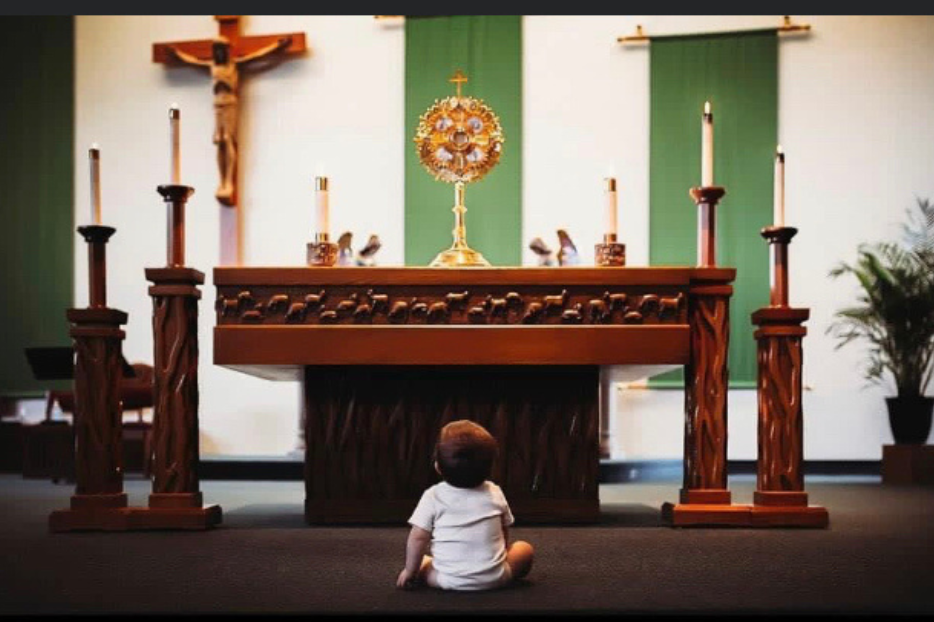
“I have spoken of teaching little children, both because it is important in itself and because it is the clearest way of bringing out what “transubstantiation”is … When one says “transubstantiation” one is saying exactly what one teaches the child, in teaching it that Christ’s words, by the divine power given to the priest who uses them in his place, have changed the bread so that it isn’t there any more (nor the stuff of which it was made) but instead there is the body of Christ. The little child can grasp this and it is implicit in the act of worship that follows the teaching. I knew a child, close upon three years old and only then beginning to talk, but taught as I have described, who was in the free space at the back of the church when the mother went to communion. “Is he in you?” the child asked when the mother came back. “Yes,” she said, and to her amazement the child prostrated itself before her. I can testify to this, for I saw it happen. I once told the story to one of those theologians who unhappily (as it seems) strive to alter and water down our faith, and he deplored it: he wished to say, and hoped that the Vatican Council would say, something that would show the child’s idea to be wrong. I guessed then that the poor wretch was losing the faith and indeed so, sadly, did it turn out.”


 Prodigal Catholic
Leave a comment