I know this book can be contentious but here are some insights that hopefully every Catholic who loves our Eucharistic Lord can fully support:
Imagine eating the sun — and imagine you could do it without perishing. What would happen? You would receive into your body the source of light and warmth. You would have within you all the light and heat that you could possibly ever need or want. No more heating bills, no more lightbulbs, no more winter trips to warmer climes. When we receive Jesus in the Most Blessed Sacrament, we receive the source of all supernatural light and warmth, the light of truth, the heat of love, for indeed He is the “Sun of Justice.” We receive God Himself, the very Son of God, Who is inseparable from the Father and the Holy Spirit. Saint Ephrem the Syrian wrote: He called the bread his living body and he filled it with himself and his Spirit…. He who eats it with faith, eats Fire and Spirit…. Take and eat this, all of you, and eat with it the Holy Spirit. For it is truly my body and whoever eats it will have eternal life. That we are not killed instantly by this contact with eternal and infinite Fire is, in its own way, a greater miracle than would be eating the sun without perishing. Our Lord protects us, courteously hiding His blazing glory lest we be overwhelmed, and gently radiating His peace. It is because we receive divine fire — a fire far more potent in the range and reach of its possible spiritual effects than any physical fire — that the worthy reception of the Eucharist is purifying, illuminating, and unitive. The Holy Eucharist does within and upon the soul that which fire does within and upon combustible matter, burning away contrary dispositions and transforming the matter into itself. But since the spiritual soul is incorruptible, the soul can become fire without perishing, like the miraculous burning bush. The Eucharist does for the soul what the fire of the sun does for the earth, spreading light, warming bodies, causing growth. As we learn from the Fathers, Doctors, and mystics of the Church, the Real Presence of Jesus has a proper effect on our soul and our body. It acts principally on the soul, for, again like the sun, Jesus radiates grace to everything that surrounds Him, everything with which He comes into contact, according to His will, “according to the measure of the giving of Christ” (Eph. 4:7, DR). 6
The Holy Sacrament of the Altar is the concentration of all of God’s saving works: they come together here like all the threads of a grand story in the final chapter. His abiding desire to save and His indescribable generosity find in this Sacrament their most outstanding — indeed, one might almost say, outlandish — expression. He is the Lover who can make reality bend to His will for the sake of reaching, touching, entering into, and taking possession of the beloved. 13
We should be brutally honest with ourselves. Sometimes we feel no attraction to the Holy Mass or the Holy Eucharist; sometimes we go out of a sense of obligation or human respect. If this is how you feel, it’s time to ask the Lord, beg the Lord, for a change of heart. Ask Him to soften your resistance, to give you a hunger and thirst for Him. “Lord, you know how it looks to me; I don’t see in myself any real desire for holiness. Please give me that desire. Make me want to be holy. Move me to do what I should do.” It is a breakthrough to be humble enough to realize that we must ask for help, even when we don’t feel like being helped. 16
From the time of the Apostolic Fathers to the present, the Church has understood the Mass to be nothing other than the redemptive sacrifice of Jesus Christ on Calvary, made present to us under the appearances of bread and wine — the forms Jesus chose at the Last Supper, the Passover meal He transformed into the first Mass. The Mass is the true and perfect sacrifice that makes possible, fulfills, and inspires all sacrifices of love. There is no unselfish love in this world that does not derive from the Cross, which translates into: from the Holy Mass offered day after day, year after year, century after century, until Christ returns in glory. As St. Pio of Pietrelcina once said: “It would be easier for the world to exist without the sun than without the Holy Sacrifice of the Mass.” 31
The offering of the sacrifice of the Cross, made present by the double consecration that symbolically separates body from blood, is therefore the central action of the Mass, the main reason it exists, the main reason we are there, and — here we have to think big — the main cause of the universe attaining its destiny. Without the continual celebration of the Mass, the world would literally fail to achieve the purpose for which God created it. The Mass is the most vital, most urgently needed, most solemn event that could ever and does ever take place. This means that the way it is celebrated, as well as our own interior attitude when we attend, should be a faithful reflection of its cosmic magnitude and mystical density. We are assisting at the world-redeeming sacrifice of Calvary, and thus we should conform ourselves spiritually to this sacrifice as Mary did at the foot of the Cross, so that we may “complete what is lacking in Christ’s afflictions for the sake of His Body, that is, the Church” (Col. 1:24). 32
Through Leviticus, the Cross, and the Mass, Our Lord is beckoning us to think of sacrifice, meaning the gift of self, as our fundamental cast of mind and way of life, rather than acquisition, mastery over others, or autonomous self-determination — all the idols that dominate the minds of modern Americans and Europeans. Our way of life is to be Eucharistic, which means, having given thanks to God and partaken of His strength even unto death, we then allow ourselves, our time, our energy, our gifts, to be blessed, broken, and distributed to others, to bring them His life. 33
For me, the Mass has the shape of a mountain in which we climb to the summit and join our Savior on the Cross, to share His life; then we climb down, as it were, to our everyday life in the valley, carrying something of that immense love to everyone we meet. In that sense, the special sacramental presence of Jesus at the heart of the Eucharistic liturgy gives shape and order to the whole. He is not present in just that way on the credence table or on the altar during the Sanctus; He becomes present, and in a definite, priestly, liturgical, ecclesial way, when the gifts are transformed. To me, this speaks volumes about the drama of the divine; there is a narrative, a movement, a climax, and we are then allowed to share in that victorious redemption. God seems to like to paint in bright colors and bold strokes, rather than in muddled grays and browns. 55
In the case of the Eucharist, the matter employed (by Christ’s institution) is wheaten bread and wine made from grapes, which are food and drink for man — the most basic food, one might say, and the best beverage nature and human art produce for our enjoyment. Thus, the proper effect of the Eucharist can be discerned from the effects of the consumption of food and drink in the one who receives them: the restoration of lost bodily matter and, should there be surplus, an increase of bodily substance, together with a gladdening of heart. To these physical effects, St. Thomas likens the sacramental effects of an increase in “spiritual quantity” (where “quantity” means the extent of active power) by the strengthening of the virtues, a restoration of wholeness through the forgiveness of venial sin or the repairing of defects, and elation of mind. 61
But if we left off our account there, we would miss the most important point. Following St. Augustine, St. Thomas says there is a crucial difference between the bodily food of any ordinary human meal and the spiritual food of Holy Communion. Bodily food achieves its effect, to restore lost flesh and increase its quantity, by being converted or turned into the one fed. Spiritual food, on the contrary — or to be more precise, Our Lord Himself, who is really, truly, substantially present in the Most Holy Eucharist — is not converted into the one eating; the one eating is rather converted into (i.e., turned ever more toward and likened unto) Christ, for He acts upon the communicant to turn him into Himself. 62
In the Sentences, Thomas simply says: “The proper effect of this sacrament is the conversion of man into Christ, that it might be said with the Apostle, ‘I live, now not I, but Christ lives in me.’”61 In addition to St. Augustine and St. Cyril, St. Thomas, devoted to the Church Fathers as he is, cites the potent words of St. John Damascene (676–749): “The fire of that desire which is in us, taking ignition from the burning coal (that is, from this sacrament), will burn up our sins and illuminate our hearts, so that by partaking of the divine fire we may be set on fire and deified.”62 When we receive the Eucharist in a state of grace, we are feasting upon this fire of love, letting it permeate and burn into all the powers and passivities of soul and body. 63
Conditions for fruitful and frequent reception: The answer was given authoritatively in the 1905 decree Sacra Tridentina Synodus of the Sacred Congregation of the Council, which reflects the mind and will of Pope St. Pius X. This pope, in response to lingering forms of Jansenism that discouraged the faithful from approaching the altar, lowered the age for First Communions and encouraged frequent reception of the Lord. The conditions are as follows. First, one who wishes to approach the sacred banquet must be morally certain that he is in a state of grace, not burdened by the guilt of any unconfessed mortal sin. Second, he must have a “right and devout intention.” The decree defines this as follows: “that he who approaches the Holy Table should do so, not out of routine, or vainglory, or human respect, but that he wish to please God, to be more closely united with Him by charity, and to have recourse to this divine remedy for his weakness and defects.” In other words, the communicant should be conscious of what he is doing and Whom he is approaching (hence, not from routine), and that he is doing it to please the Lord and sanctify his soul through a closer union with Him, not because of what others may be thinking (hence, not from vainglory or human respect). Third, while it is fitting that he should be free of fully deliberate venial sins and any affection for them, he should at least be free from mortal sin — and in such a way that he has the intention of never sinning mortally in the future. This is a particularly important point today, in the huge mess created by Pope Francis’s Post-Synodal Apostolic Exhortation Amoris Laetitia. As long as a Catholic intends to continue living in sin, that is, cooperating in an objectively sinful situation, such as a civil marriage with another partner while the original spouse is still alive, he or she may not receive Holy Communion.77 Fourth, while it is not absolutely required that a communicant have spent time in careful preparation or that he spend time afterward in thanksgiving, both of these — the preparation and the thanksgiving — are vital to obtaining the full benefit of reception of the Holy Eucharist. As the decree puts it: “the sacraments…produce a great effect in proportion as the dispositions of the recipient are better.” Apart from the hidden intentions of God who wills to elevate some souls higher than others, it is, on our part, the exercise of a lively faith and the stirring up of actual devotion in approaching the altar and communing with the Lord that accounts for the difference between those whom frequent Communion transforms into saints and those who seem to be left relatively unaffected even by daily contact with the Lord. In brief, the four conditions for frequent and fruitful reception of Holy Communion are: (1) being in a state of grace, (2) having a right and devout intention, (3) being free from attachment to sin, in the sense of intending not to sin in the future, (4) making due preparation and thanksgiving. What will be the result if we follow the wise counsel of Holy Mother Church? The same decree puts it beautifully: “by the frequent or daily reception of the Holy Eucharist, union with Christ is strengthened, the spiritual life more abundantly sustained, the soul more richly endowed with virtues, and the pledge of everlasting happiness more securely bestowed.” What a privilege — and what a challenge to us to order our lives so that we may grow in grace, purity, faith, and devotion! 73-5
On the discipline of fasting before communing: The decree summarized above does not mention fasting, but fasting before partaking of the Bread of Angels has been a custom practiced universally since ancient times, and required by canon law in its various forms. When we fast from earthly food, the resulting hunger reminds us of how God alone is the nourishment of our souls, the source of our health, the giver of our joy. Just as a full stomach naturally clouds our minds and inclines us to rest, an empty stomach clarifies inner sight and opens the ear of the heart. 75
A significant Eucharistic fast shows our respect for Our Lord, and our desire to receive Him as the most important nourishment of our lives. It also makes a moral demand on us that underlines the obligation of worthy reception: be attentive, Christian man or woman, to what you are proposing to do; think deliberately about whether you are in a state of grace such that you may worthily approach the Lord Jesus Christ and receive Him in so intimate a way. The three-hour fast was simultaneously about the Lord, giving Him honor, and about me, taking my state into account. It was a discipline that discouraged unthinking, indifferent, “social” Communions. 76
The primary and inherent purpose of the Mass as such is to adore, praise, placate, and supplicate the Most Holy Trinity. It is the perfect act of divine worship, by which the Father is well pleased with the Son; through it, the Church Militant receives an outpouring of grace, the Church Triumphant an increase of joy, the Church Suffering an alleviation of pains. The truth of the inherent value of the Mass was better understood in olden times, when people spoke of “assisting at Mass.” We assist in this outpouring, this increase, this alleviation, by our presence and our personal prayer united to the Holy Sacrifice. We are already mightily blessed simply to be there for this august Mystery, this all-worthy Offering. Even if there were nothing else “in it for us,” so to speak, the Holy Sacrifice of the Mass, all by itself, would give us matter for a lifetime and, indeed, an eternity of thanksgiving. In heaven, the communion we enjoy with God is so perfect there is no need any more for sacraments, yet the worship of the Mystical Body still continues — the Son still offers His divine humanity and His holy wounds to the Father, and we offer ourselves with Him. 81
As a general rule, it’s fair to say that those who are properly disposed, with living faith and actual devotion, and conscious of no impediment, ought to receive: thirsty men in a desert should drink the water provided for them. No doubt Augustine, Aquinas, Pius X, and Ratzinger would concur. 82
When we have received Our Lord in Holy Communion, He is, for some precious minutes, substantially present within us. If we are in a state of grace (and we’d have no business receiving Communion otherwise), He is always with us spiritually; but He is not always with us in the miraculous mode of His Eucharistic presence. This is a special time, a time of unique intimacy and love, when our praises to God and His favors to us are poured out more abundantly, when we are most of all abiding in Him and He in us. Let us not squander this gift from the Lord — and let the clergy lead the way in setting a strong and sincere example of how to rejoice and give thanks. I am reminded of the saying recounted by Dom Jean-Baptiste Chautard: “If the priest is a saint, the people will be fervent; if the priest is fervent, the people will be pious; if the priest is pious, the people will at least be decent. But if the priest is only decent, the people will be godless.” He then adds his own observation: “The spiritual generation is always one degree less intense in its life than those who beget it in Christ.” 87
Satan derives a demented pleasure from seeing the Holy Eucharist profaned and desecrated. This happens in two ways: through negligence, as when people carelessly drop fragments of the Host or spill the precious Blood; through contempt, as when non-Catholic visitors and tourists receive the Blessed Sacrament, or when anti-Catholics deliberately carry them away in order to destroy them, use them in satanic worship, or sell them online. When we ponder the awesome mystery that is the Holy Eucharist, such evils should cause us immense anguish, sadness, and righteous anger. 94
Receiving Communion Kneeling and on the Tongue: This mode of receiving — common to East and West — symbolizes and emphasizes several truths at once.
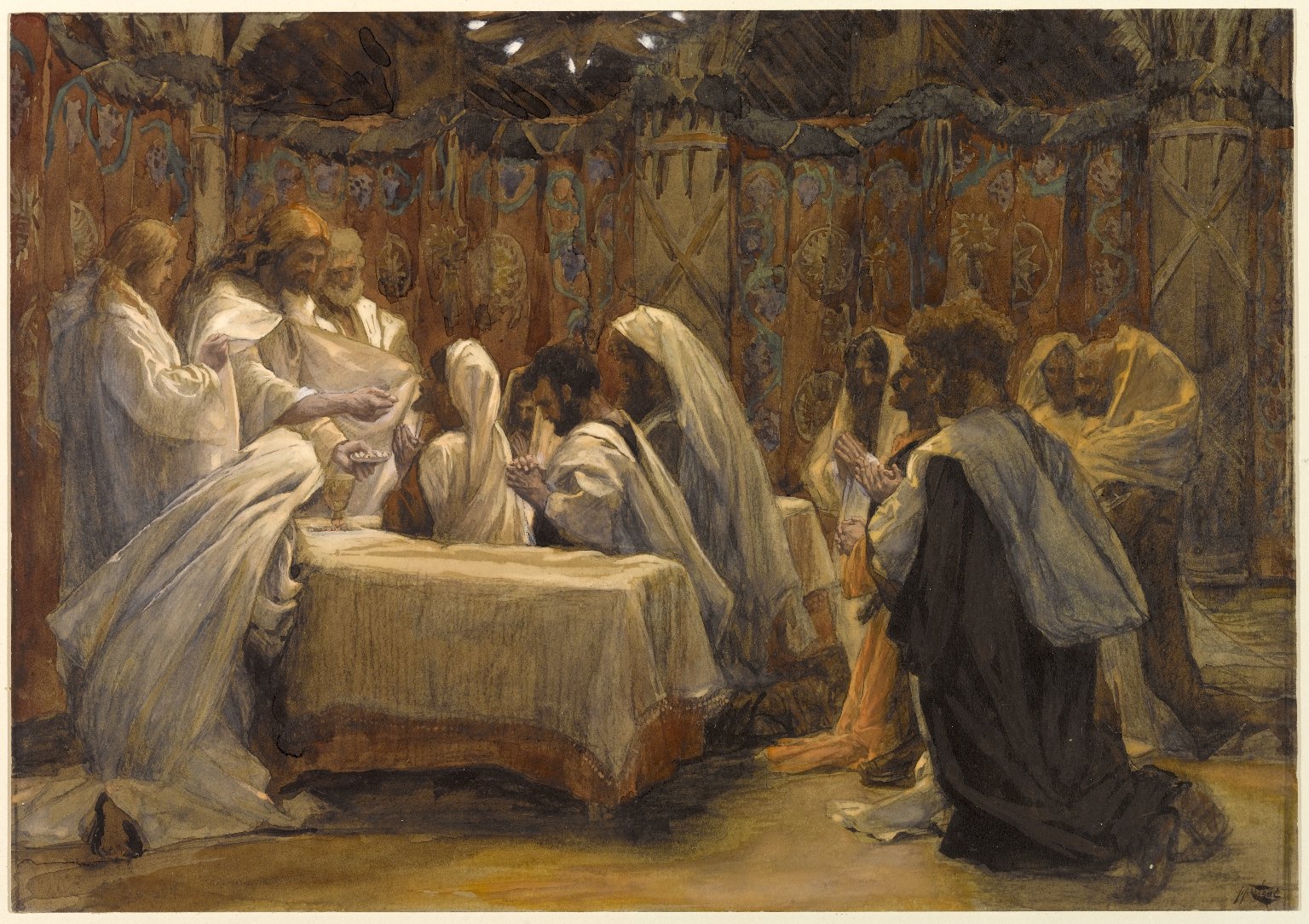
In his painting “Communion of the Apostles,” James Tissot (1836–1902), who researched his biblical art with exceptional care, envisions the Lord feeding the apostles as is customary in the Middle East, where a friend may place food in his friend’s mouth, or a lover in that of his beloved, at least on special occasions (think of the custom of the bride and bridegroom feeding cake to one another at the wedding reception). Msgr. Bux points out that the Gospel of John implies this manner of feeding (John 13:26-27).
- The one doing the feeding is Christ. I do not feed myself. Humility: Kneeling, according to St. Thomas Aquinas, is a symbol of humility insofar as it (1) subjects man to the one he genuflects before (& Jesus our Lord and we are His servants); (2) confesses his lack of strength since the knees are a sign of strength. “According to Abba Apollo, a desert father who lived about 1,700 years ago, the devil has no knees; he cannot kneel; he cannot adore; he cannot pray; he can only look down his nose in contempt. Being unwilling to bend the knee at the name of Jesus is the essence of evil (cf. Is 45:23, Rom 14:11)” (Olmsted, Knees to Love Christ, 2005).
- 2. I am, in fact, incapable of nourishing myself supernaturally; I must be fed, like a little child, an elderly person, or someone handicapped. Yes, I am able to come forward to the communion rail, unlike the paralytic carried on a pallet in the Gospel (see Luke 5:17–26); but once I reach the threshold of divinity, it is imperative that I demonstrate — to myself and in the sight of others — that at this threshold I must kneel or take a passive stance and allow myself to be acted upon.
- The food is entering immediately into my body — that is, I surrender myself to the coming of the Word from without, and make myself passive and receptive to it: in a word, vulnerable. I am not “in control”; I am not the one who determines the conditions or the timing under which Christ will act on me. By coming forward and submitting to the hand of another, I relinquish my mastery. There is no moment between reception and eating; to receive is to eat.
- More particularly, we wait for the Lord (see Luke 12:37).
- There is a clear hierarchical distinction between the one giving the divine gift and the one receiving it. Because the communicant kneels down at an altar rail or prie-dieu while the priest or deacon remains standing, there is a strong differentiation of persons and actions.
What is a worthy Communion? St. Thomas says, a worthy Communion means that you receive in a state of grace with lively faith and actual devotion. So, what he means is that you do not just go up by routine, because everyone else is going up and you receive because your parents or your neighbors are receiving, and you don’t even know what it signifies. That would be without faith. We need to have real conscious faith that we are going to receive the Lord Jesus and actual devotion — not just habitual devotion: I was devout last week, or I am capable of being devout — by actually encouraging myself right now to make acts of faith, hope, and charity and asking God to sanctify me, cleanse me, and transform me. So, freedom from the guilt of mortal sin, lively faith, and actual devotion are what we need for a worthy Communion. In that sense we can have a worthy Communion or an unworthy Communion. 141
Extra:


 Prodigal Catholic
Leave a comment